
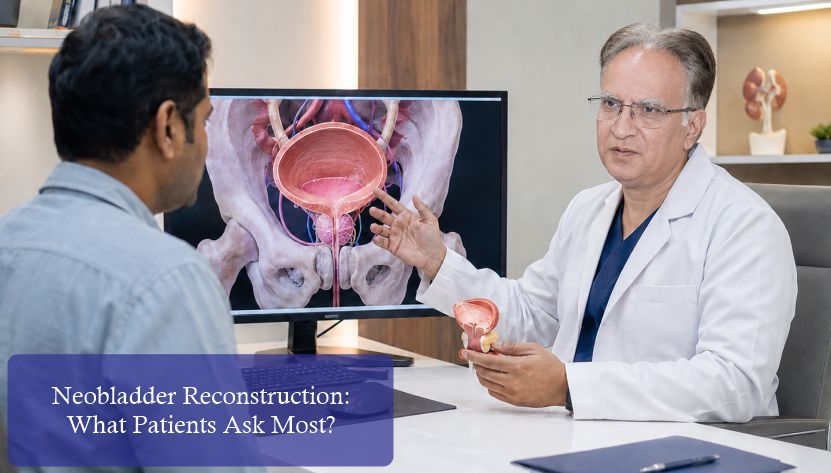
Neobladder Reconstruction: What Patients Ask Most?
A bladder cancer diagnosis is life changing. And when your doctor recommends a radical cystectomy, the surgical removal of the bladder, it raises an immediate and deeply personal question: what happens next?
How will my body handle not having a bladder? Will I need a bag attached to me for the rest of my life? Can I go back to normal?
These are questions we hear every day at Gujarat Uro Oncology. And the answer, for many patients, is more hopeful than they expect.
Neo-bladder reconstruction, also called an orthotopic neobladder, is a surgical technique that creates a new, internal bladder using a section of the patient's own intestine. It allows many bladder cancer patients to urinate naturally after surgery, without an external bag or pouch.
This blog answers the most common questions patients and their families ask about neo-bladder reconstruction in plain, honest language.
What is Neo-Bladder Reconstruction?
When the bladder must be removed to treat bladder cancer, known as radical cystectomy, the surgeon needs to create a new way for the body to store and pass urine. There are several urinary diversion options available, and neo-bladder reconstruction is considered the most natural alternative.
In this procedure, the surgeon uses approximately 40 to 60 cm of the small intestine, known as the ileum, to fashion a spherical pouch called the neobladder. This pouch is then connected directly to the urethra, allowing the patient to urinate through the natural passage, the same way they did before surgery.
The intestinal segment used is carefully selected and reshaped, so it no longer absorbs food. It functions purely as a urine reservoir.
Neo-Bladder vs Other Urinary Diversion Options
After bladder removal, patients are generally offered three types of urinary diversion:
| Feature | Ileal Conduit Urostomy Bag | Continent Pouch | Neo-Bladder |
|---|---|---|---|
| Urination Method | External bag | Self-catheterization | Natural urination |
| External Appliance | Yes, always | No | No |
| Body Image Impact | Significant | Moderate | Minimal |
| Continence Control | Not applicable | Partial | Achievable |
| Recovery Complexity | Simpler | Moderate | More involved |
| Best Suited For | Older or complex cases | Selected patients | Eligible, motivated patients |
Who is a Candidate for Neo-Bladder Reconstruction?
Not every patient is suited to a neobladder. Your uro-oncologist will assess several factors:
- • Cancer has not spread to the urethra or nearby structures
- • Good kidney function to handle the new reservoir
- • No significant bowel disease or prior intestinal surgery
- • Adequate pre-surgery urinary sphincter function
- • Patient's motivation and ability to manage the learning curve of new urination habits
- • Overall fitness and absence of conditions that complicate long surgery
Age alone is not a disqualifying factor. Many patients in their 60s and 70s have successfully undergone neo-bladder reconstruction with excellent outcomes.
How is Neo-Bladder Reconstruction Performed?
Step 1: Radical Cystectomy
The bladder and, in men, the prostate are removed. In women, the uterus and part of the vaginal wall may also be removed depending on cancer spread. Nearby lymph nodes are dissected to check for cancer spread.
Step 2: Intestinal Segment Harvest
A 40 to 60 cm segment of the ileum, which is part of the small intestine, is carefully isolated. The remaining intestine is rejoined so normal bowel function continues.
Step 3: Pouch Formation
The harvested intestinal segment is opened, folded, and shaped into a spherical low-pressure pouch designed to hold urine without creating the same kind of contractions as the intestine.
Step 4: Connection to Urethra and Ureters
The neobladder is connected to the urethra at the bottom for voiding and to both ureters at the top to receive urine from the kidneys. This restores the natural flow of urine through the body.
Step 5: Robotic Precision
At Gujarat Uro Oncology, neo-bladder reconstruction is performed using robotic-assisted or laparoscopic techniques wherever possible, minimizing blood loss, reducing hospital stay, and accelerating recovery compared to open surgery.
The Most Common Questions Patients Ask
Q1: Will I be able to urinate normally after surgery?
Yes, but it takes time and practice. The neobladder does not have the same nerve signals as a natural bladder. You will learn to urinate by relaxing the pelvic floor muscles and applying gentle abdominal pressure. Most patients achieve good daytime control within 3 to 6 months.
Q2: Will I have urinary leakage, especially at night?
Nighttime leakage, known as nocturnal incontinence, is the most common challenge. Because the neobladder has no nerve signals to wake you when it is full, the sphincter must do all the work. Most patients set an alarm to urinate every 3 to 4 hours at night initially. Over time, many develop better night-time control. Pelvic floor exercises before and after surgery significantly help.
Q3: Will I need a catheter after surgery?
Yes, temporarily. A urethral catheter stays in place for 3 weeks after surgery to allow the neobladder to heal. After it is removed, you begin the process of learning to urinate with your new bladder under the guidance of your care team.
Q4: How long is the recovery?
Hospital stay is typically 7 to 10 days. Most patients return to light daily activities in 4 to 6 weeks. Full adaptation to the neobladder, including confident urinary control, usually takes 6 to 12 months. This is normal, and your team will support you throughout.
Q5: Will this affect my sexual function?
This depends on whether nerve-sparing surgery is possible for your case. In men, nerve-sparing radical cystectomy aims to preserve erectile function. In women, sexual sensation may be affected if vaginal tissue is involved. Your surgeon will discuss this in detail before the procedure.
Q6: Are there dietary restrictions after neo-bladder reconstruction?
Initially, a soft, easily digestible diet is recommended as the bowel heals. Long-term, most patients return to a normal diet. Adequate hydration is essential because the neobladder needs to be flushed regularly to prevent mucus build-up from the intestinal lining.
Q7: Will I still need cancer follow-ups after surgery?
Absolutely. Regular follow-up with your uro-oncologist is essential, including imaging, blood tests, and urine cytology, to monitor for any cancer recurrence and to ensure the neobladder is functioning well.
Q8: Is neo-bladder reconstruction available in Ahmedabad?
Yes. Gujarat Uro Oncology at HCG Aastha Cancer Centre, Ahmedabad, performs neo-bladder reconstruction using advanced robotic and laparoscopic techniques. Our team has extensive experience in urinary diversion surgeries and post-operative rehabilitation for bladder cancer patients.
Life After Neo-Bladder Reconstruction: What to Expect
The first 3 to 6 months require patience, discipline, and trust in the process. Here is what the recovery journey looks like:
- Week 1 to 3: In hospital and at home with catheter. Rest, hydration, wound care.
- Week 4 to 6: Catheter removed. Begin voiding trials. Pelvic floor exercises start.
- Month 2 to 3: Gradual improvement in daytime control. Night leakage is still common, so protective pads and urination alarms may be needed.
- Month 4 to 6: Most patients achieve reliable daytime continence. Night-time control keeps improving.
- Month 6 to 12: Most patients report good quality of life, confident voiding, and return to regular activities including work and travel.
Tips for a Smoother Recovery
- • Drink at least 2 to 3 liters of water daily to flush the neobladder and prevent mucus build-up
- • Do pelvic floor exercises, also known as Kegel exercises, every day starting before surgery if possible
- • Urinate on a schedule: every 2 to 3 hours during the day and every 3 to 4 hours at night
- • Do not wait for the urge, as the neobladder may not send one initially
- • Lean slightly forward while urinating to help empty the pouch completely
- • Attend every follow-up appointment without fail
- • Speak openly with your care team about concerns such as incontinence, mucus, or discomfort
Conclusion
Bladder removal is a major surgery, but it does not have to mean a diminished life. Neo-bladder reconstruction offers eligible patients the closest possible return to natural urinary function, preserving dignity, body image, and quality of life after bladder cancer treatment.
The road to recovery takes time and commitment. But with the right surgical expertise, the right support, and the right mindset, most patients are amazed at how well they adapt and how fully they return to everyday life.
If you or a loved one is facing a bladder cancer diagnosis or has been advised radical cystectomy, do not make decisions without a full, honest conversation with a specialist who can assess whether neo-bladder reconstruction is right for you.
Contact Us
The Gujarat Uro Oncology Associates team offers expert consultation, diagnosis, second opinions, and treatment planning for urological cancers. To learn more or book an appointment, contact 91 75730 04253 or email bakshihemang@yahoo.co.in.